Vesture Part 2
by Fr. Gabriel, O.S.B. | 06/14/2026 | Weekly ReflectionDear Parishioners,
Continuing to reflect on the liturgical vesture – what it consists of and what it means, there are two other garments that were not included in last week’s article. The first of these is the cincture. The cincture is typically a cord-like belt worn around the waist of anyone who wears an alb. Its use is optional and practical.
It allows a minister to shorten the length of his/her alb by pulling up the sides of the garment and tucking it under the cincture. Priests sometimes tuck the stole under it in order to keep it in place.
Another garment that we see more frequently, since the re-establishment of permanent deacons, is the dalmatic. This is an outer garment worn by deacons which frequently complements the chasuble of the priest in terms of color and material. The deacon’s stole, worn over his right shoulder and fastened at his left side near the waist, is worn under the dalmatic. The unique feature of the dalmatic is its square cut in front and back with sleeves for the deacon’s arms. The sleeves are a significant design feature because they represent the deacon’s ministry in the liturgy. The word deacon is derived from a Greek word which means servant. We know from the writings of the New Testament and the testimony of early church documents that deacons were ordained as public servants of the various faith communities that were emerging. They ministered to widows, orphans, the sick, and the dying. They were also given charge of church temporalities, including the sacred vessels and the books or scrolls used for worship. This ministry made them the most appropriate representatives of the community to announce the petitions, as they do today, alerting those who had gathered to the needs of their fellow Christians. During the liturgical ritual, the deacons were responsible for the many manual actions such as: receiving the gifts of bread and wine from the assembly, arranging these gifts on the altar, giving instruction and direction during the rite, distributing the consecrated wine, and taking Holy Communion to the absent. The sleeves on their dalmatics then and now, allow for greater freedom of movement with their arms so that they might accomplish the various ritual tasks of their ministry with greater ease.
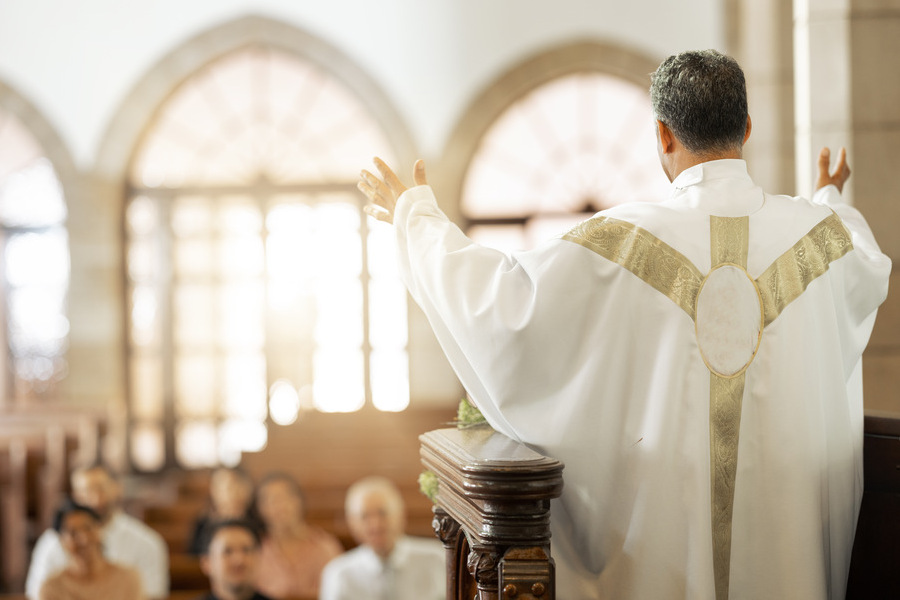
Throughout the centuries, most of the vestments for the church’s ministers underwent numerous adaptations in terms of design. In the Middle Ages, a distinction among the liturgical feasts was made evident by the color of vestments: white or gold for the most joyful commemorations, violet for the somber penitential seasons of Advent and Lent, red for the martyrs, feasts of the Holy Spirit, and for the Passion of Jesus, green for the days of Ordinary Time, and black for funerals and rituals for the dead. This allowed for a visual connection.
Also during the high Middle Ages, vestments became vehicles for catechesis as elaborate designs that included images of saints, angels, and scenes from the Bible were woven into the design of these garments. As a result of this ornamentation, the garments became so heavy that it became necessary to shorten them and lessen the fullness of their fabric. The liturgical reforms of the Second Vatican Council called for a return to the earlier styles of vesture. An emphasis was placed on a noble simplicity that would be visible in an ample, fuller design and in the quality of the fabric itself.
Excessive ornamentation, however beautiful, created a mentality of placing one symbol on top of another, thereby diminishing the original and fundamental sign value of the garment. Today, the official liturgical reminds us that sacred vesture is intended to serve two essential purposes – to bring beauty to the ritual celebration and to designate and identify the diversity of ministers.
Unfortunately, the official documents do not comment on the attire of the majority of those who have gathered for worship but who do not have a specific function or an ordained vocation. Architects, like Louis Sullivan, have been known to claim that Form follows Function – meaning, whatever the purpose or function of a building might be, should be obvious in the form it is given. The same could be said of our clothing and visual appearance. The “form” through which we present ourselves by means of our clothing ought to respect the “function” in which we are engaged at the time.
It is undeniable that in recent decades, Americans have chosen to dress down and eschew the more formal dress of bygone years. Occasions of formality, such as weddings and funerals, are rare exceptions. We might reflect on what this preference for informality, which is also very evident in acts of worship, has done to shape our understanding of the church’s public prayer. Has it lessened, inadvertently, the importance of Sunday Mass and created a mentality that is counterintuitive to what we intend when we gather for the sublime worship of God. While we know that God does not need our worship nor is God moved by the quality of our dress, how we present ourselves matters to one another. It reveals the importance not only of what we do, but the appreciation we have for one another. We are a people who depend on our senses to grasp the meaning of life. Might this also be true about the way we pray as a redeemed people united in love for God and one another?
BACK TO LIST