Posture
by Fr. Gabriel, O.S.B. | 06/21/2026 | Weekly ReflectionDear Parishioners,
This is the third in a series of bulletin articles on the liturgical topics of Gesture, Vesture and Posture. The following reflections focus on the topic of posture. I begin by recounting a famous interview conducted with Martha Graham (1894 – 1991), the highly regarded American dancer and choreographer who is universally recognized as the “Mother of Modern Dance.”
After the stage performance of a dance that she herself designed – a dance that was most likely a combination of classical ballet with an expressive and uniquely American flair, the interviewer asked Ms. Graham what the dance meant. She was hoping to uncover the hidden meaning behind the various postures, gestures and movements that comprised the dance. Ms. Graham responded by stating, If I could have explained its meaning, I would not have had to dance it. Her provocative answer to the interviewer is a reminder that our bodies have a language all their own and that some truths or realities cannot be expressed by words but require our bodies to communicate their essence.
Admitting this fact allows us to appreciate the indispensable role that bodily postures play in our worship of God. Words don’t say it all. Human beings from the beginning of time have grasped this truth perhaps even better than contemporary men and women. This is why so-called “primitive” cultures made such extensive use of dance in their tribal rituals. This is how they expressed, deepened and handed on their identities and supreme values. As people developed their own national languages, forms of communication tended to become more verbal in nature rather than bodily. Nonetheless, as we learn from Martha Graham as well as other artists, there are certain truths that may not require words and that are more clearly expressed through our bodies. This is certainly in keeping with our Catholic understanding of the human person who, by God’s design, is an embodied being composed of body and soul. Our bodies are not a liability for our immortal souls but are the indispensable means by which we exist in the world. Our bodies are the medium that allows us to establish relationships with God, one another and creation. We might rightfully think of our bodies as the primordial sacrament – the visible sign of an invisible grace.
With this foundational understanding we can better appreciate the different postures that are incorporated in our worship. They are far more than pragmatic movements and positions our bodies assume. They are a language unto themselves if we take the time to plumb the depth of their meaning. Walking, for example, is more than the means to get from point A to point B. If that weren’t the case, we have no need for processions that take us down church aisles, through city streets and rural fields and finally to cemeteries where our flesh and bones are returned to the earth. Walking can be a sacramental event in itself to manifest God who is walking among us on the journey we call life.
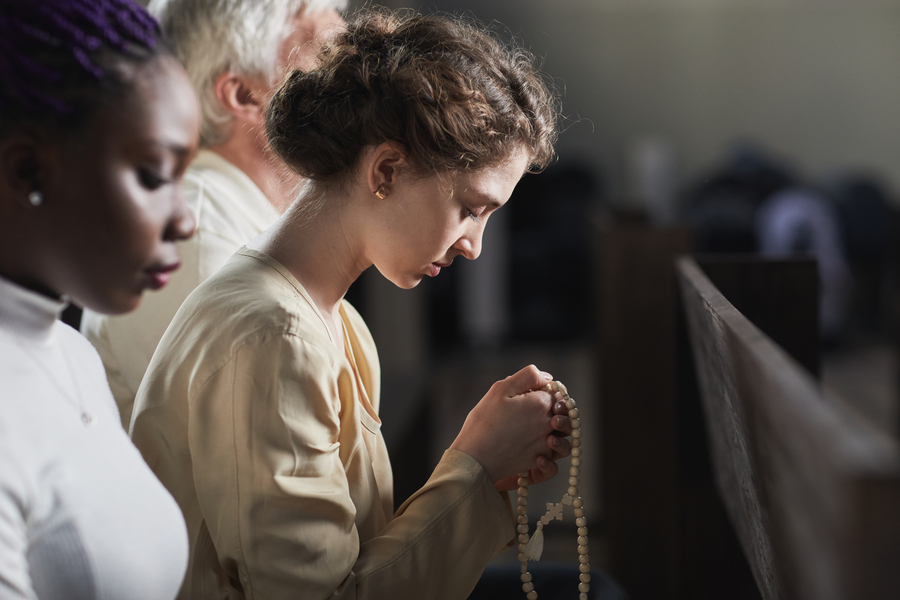
Standing is a posture we take on at moments in the Mass to show great respect. We stand when the liturgical ministers enter. We stand at the Gospel during which the words and actions of Jesus are proclaimed in a solemn manner. We stand during the Profession of Faith (Creed) and for the petitions of the Universal Prayer. Essentially, we stand at any time God is addressed. We stand as the redeemed people God has raised up and claimed as God’s own. An exception to this rule is the Eucharistic Prayer which begins while we are standing and then continues while we kneel. The most ancient practice in Christian worship was for the assembly to stand for the entire Eucharistic Prayer that begins with the priest inviting those gathered to lift up their hearts. Over time, the posture of kneeling was introduced in the Eucharistic Prayer immediately after the Holy, Holy (Sanctus). Kneeling was originally a penitential gesture that expressed humility and sorrow for sin. It was also the posture a knight would assume before his lord during the Feudalistic times. During the Middle Ages when there was an ever-increasing sense of personal unworthiness and human depravity, kneeling became a more standard posture for people during the Mass as well as times of adoration.
Unfortunately, kneeling has become, for some Catholics, the measuring rod of an individual’s devotion and sincerity. This is evident in some churches where the faithful are encouraged to kneel for the reception of Holy Communion. Since the liturgical reforms of the Second Vatican Council, the standard, unifying posture for receiving Communion was standing. Gradually, some individuals began to kneel when they came up for Communion. Ministers were reminded that, while standing is the norm, no one should be refused Communion if they knelt. As more people began to kneel at this time, the bishops of the U.S. made a very slight change in their previous directive that allowed for kneeling, even though standing is still normative. Sadly, this has become a sign of disunity at the very moment of the Mass when we are expressing our unity as the Body of Christ by receiving the Body and Blood of Christ.
While I doubt that this is the intention of most people who kneel at Communion, it does however, communicate a type of hubris as if standing, like the rest of the assembly, is not good enough. In religious life this is called “singularizing” one’s self -- that is, calling attention to one’s individual action or attitudes for the purpose of winning admiration and attention. When challenged on this, those who choose to kneel maintain that it is a personal choice and not an indictment against others. My response to this sentiment is to assert that the church’s public worship is not about an individual’s personal choice. It is a communal corporate action in which the unity of the community gets expressed in common postures and gestures.
Another posture in ritual prayer is sitting. We may think of sitting as something so ordinary and mundane that its importance can get overlooked. But sitting is a posture we assume when we are called upon to listen attentively as students in a class, or attendees at a concert. Sitting is the posture of a judge when he/she renders a verdict. Sitting is the posture we adopt when we wait in silence.
Bowing is a posture we use to show respect as when we bow before the altar or a sacred image. We bow before receiving the host and chalice at Communion as a bodily recognition that these sacramental signs are the presence of Christ’s body and blood. In some places, bowing is done at the Sign of Peace, replacing a handshake or full embrace. This may be a cultural custom. In monastic communities monks and nuns bow to one another to show their belief that Christ is present in the other.
Genuflecting is a posture typically reserved for the Blessed Sacrament and the Holy Cross. Because of bodily limitations, some individuals are not able to genuflect and so rightfully replace this posture with a profound bow. Genuflecting has a powerful way of expressing human vulnerability and lack of steadiness both of which are true of human beings in the presence of God.
These are the most commonly observed and practiced postures in Catholic Worship. They not only add to the beauty of our sacred rituals they allow our bodies to speak a language that is formed in the heart and that seeks a way to manifest itself visibly.
BACK TO LIST