Gestures Part 4
by Fr. Gabriel, O.S.B. | 05/24/2026 | Weekly ReflectionDear Parishioners,
Continuing to reflect on those liturgical gestures that are reserved to the priest celebrant at Mass, there is a sub-category of these gestures that pertain to the sacred elements alone, i.e., the bread and wine before or after the words of consecration.
Although historically, there are some descriptive accounts of the earliest celebrations of the “Breaking of the Bread” (also called “The Lord’s Supper,” “The Mass” or the “Divine Liturgy”), there are even fewer descriptions of how the bread and wine were handled during in these rituals. There is also a question of what kind of bread was used. Not all biblical scholars agree that the Last Supper of Jesus was a Passover Meal, i.e., the annual ritual meal that God commanded Moses and the Israelites to celebrate the night before they left Egypt. Even the New Testament writings differ on this point. The synoptic gospels would seem to indicate the Last Supper was in fact a Passover Supper, while the gospel of John does not. For John, the lambs that would be eaten during Passover were being slaughtered in the temple at the time Jesus was being crucified. This difference could be John’s attempt to show, symbolically, how Jesus is the new Lamb of God who replaces the former Passover Lamb.
But if we were to maintain that Jesus’ Last Supper was a Passover Meal, then the bread used for this ritual would have been unleavened, that is, baked without yeast according to ancient custom. This being the case, however, unleavened bread did not become a requirement for the Lord’s Supper as it continued to be celebrated by the early Christians. Evidence shows that the bread used for the Lord’s Supper was baked by the people and brought from their homes to these gatherings. There is even evidence that some of the consecrated bread was taken home by ordinary people and kept in their homes for reception throughout the week. Although in these incipient rites the word “consecrated” was not used to describe what happened to the bread at the Lord’s Supper, there seems to have been no doubt in anyone’s understanding that this bread was indeed the Body of Christ as Jesus intended it to be. It will take centuries of theological pondering to arrive at explanations that later became traditional for explaining what “Body of Christ” meant from a sacramental perspective. Christians nonetheless believed that the sacred bread and wine of the Eucharist was a heavenly food and a miraculous gift that made the Risen Christ (not the historical Jesus) present to baptized believers.
The hand gestures that were organic to the early celebrations of the Lord’s Supper were simple and few. Lay people baked and then presented the bread at the ritual meal, the celebrant or the deacon received the bread and placed it on the altar table, and then, after a lengthy prayer of thanksgiving offered by the bishop or presbyter, the one loaf of bread was broken into smaller pieces so that it could be distributed to the participants. The unity of the Christian community was expressed in the powerful symbolism of the one loaf that was broken into many pieces as we read in St. Paul’s letter to the Romans, we though many are one body in the Lord. (Romans 12:5) Deacons may have assisted in fractioning the one loaf of bread. Then prior to the actual distribution of the holy food, the celebrant would lift up the paten on which the bread was placed (or he may have lifted a large portion of the bread) and exclaimed aloud Holy Things for the Holy. The Holy things referred to the Eucharistic bread and wine, and The Holy was a reference to those who would receive it. This joyful acclamation was an invitation for the participants to approach the altar and receive communion.
Communion was received in the hand as attested to the catechetical instructions of St. Cyril of Jerusalem, who in 386 wrote, with your right hand, make a throne for your left hand which will receive the King. He also instructed the communicants to bow before the chalice of the Blood of Christ in the manner of one who worships. In 430, St. Augustine declared that no one eats the Body of Christ without first worshipping it. This could refer to an attitude of faith or to the ritual act of bowing to the consecrated gifts. Around the year 700, at the end of the Eucharistic Prayer at a Mass presided over by the pope, the deacon would raise the chalice of wine toward the pope, who would touch it with the vessel holding the consecrated bread.
All of these early descriptions reveal that actions that involved touching the consecrated elements were rare in the context of the Mass, as were the ceremonial gestures of adoration. The common posture for receiving Holy Communion was standing as one would do in the presence of a royal figure. Kneeling was a penitential posture that got woven into the Mass because of Feudalistic influences.
Over time, because of a growing sense of sin and personal unworthiness on the part of the laity, reception of Holy Communion became infrequent. There were instances when the only person who received Communion at Mass was the priest. This became so normative that in 1215, at the Fourth Lateran Council, the Church found it necessary to mandate that at least once a year, during the Easter Season, the baptized must receive the Eucharist. Along with a profound sense of unworthiness came an inordinate scrupulosity toward particles of the consecrated bread and a fear of spilling the Precious Blood. People began to receive communion only on the tongue, and eventually, distribution from the chalice was withdrawn from the laity altogether. One can see how these ritual developments in the Middle Ages were such a radical departure from original action and intention of Jesus, who commanded his disciples to Take and Eat and Take and Drink.
While the laity were reluctant to receive the Eucharist as food, they nonetheless nurtured an intense desire to look upon the consecrated host. This is sometimes referred to as “Ocular Communion” – that is, communion through the eyes. It is during this time, in the 12th & 13th centuries, that multiple ritual gestures pertaining to the consecrated elements were incorporated into the mass especially at the time of consecration when the words of Jesus from the Last Supper were quoted by the priest in the Eucharistic Prayer, i.e., This is my body which will be given up for you. And this is the cup of my blood which will be shed for you and for many... The priest, whose back was to the people, elevated the host and the chalice separately as a bell rang, calling people’s attention to this moment in the Mass, which they may not have understood linguistically because the liturgical language was Latin. These elevations of the sacred elements were followed by genuflections of the priest as gestures of adoration. While such practices were pastorally beneficial for the laity, they had the negative impact of making the Eucharist seem more like an object rather than the action of gathering, listening to the Word of God, Offering the Great Prayer of Thanksgiving and then receiving the Holy Food. With such heavy emphasis on the Sacred Elements, there emerged a ritual imbalance with less attention being given to the other forms of Christ’s presence in the Mass, namely in the community, in the priest, and in the Scriptures.
The liturgical reforms of the Second Vatican Council attempted to restore this balance. It also simplified and regulated the four moments when the elements of bread and wine are touched in some fashion. The first of these is at The Preparation of the Gifts”, once called “The Offertory.” In the instructions or rubrics, the priest is to take the paten with the bread and holding it slightly raised above the altar with both hands prays the words, Blessed are you Lord God of all creation. He does the same with the chalice.
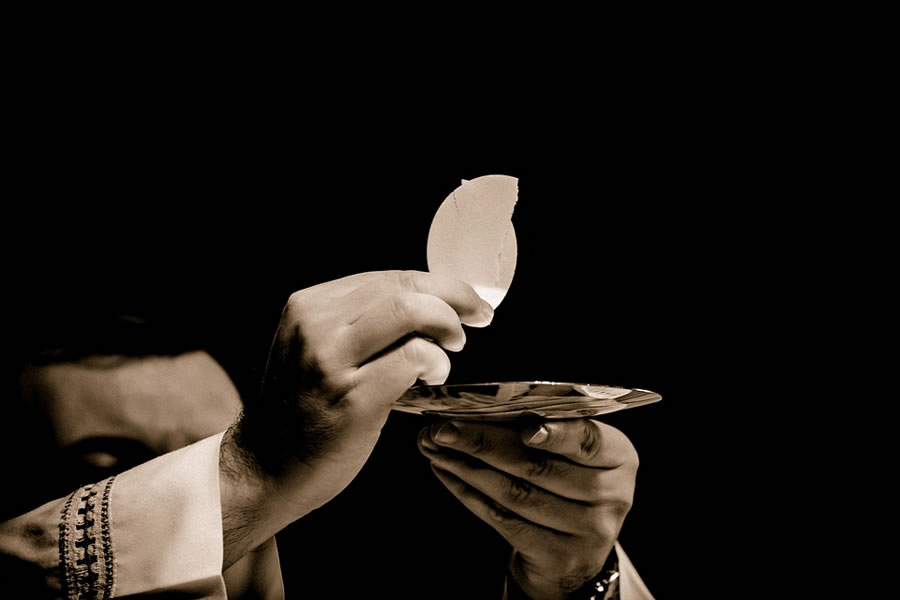
The second handling of the elements is during the Eucharistic Prayer, at what we commonly refer to as the consecration. The rubrics instruct the priest to hold the bread slightly raised above the altar during the words he took the bread and giving thanks, broke it, and gave it to his disciples saying... The priest is then to bow slightly as he says, Take this all of you and eat of it, for this is my Body which will be given up for you. The rubrics say the priest is to show the consecrated host to the people, place it on the paten and then genuflect in adoration. The same is done with the chalice. Notice the use of the word show as opposed to elevate. Although the actual level or height is not specified, many liturgists interpret show to me chest high. The rite is attempting to avoid the notion of this being the time of offering or oblation of Christ to the Father.
The third time the elements are taken in hand is at the end of the Eucharistic Prayer at the time of the Doxology. The doxology is the final acclamation that brings the whole Eucharistic Prayer to its summation. Here, the priest is instructed to raise or elevate the chalice and the paten with the host. This is the highest lifting and is intended to express the action of offering of the consecrated gifts to God. We, along with Christ, are made part of this offering.
And finally, the fourth time the sacred elements are shown to the assembly is after the Lamb of God when the priest holds the host slightly over the paten or above the chalice and says, Behold the Lamb of God...
Of course, during the distribution of Communion, the priest and/or the Communion Minister raises the host slightly and shows it to each communicant while saying The Body of Christ.
While such minute detail and subtle distinctions in handling the sacred elements may seem meaningless or scrupulous to some, it shows how carefully the church regards its most important expression of public prayer realizing that details matter. When done well, they deepen faith. If done poorly, they weaken faith.
BACK TO LIST